

Is Pilates Hard? 6 Common Myths About Pilates (And the Truth)
Updated: Sep 7

If you've ever talked yourself out of trying Pilates because you'd heard it was just stretching, or assumed you weren't flexible enough, or didn't think the results would stack up, you're not alone. Pilates is one of the most misunderstood movement practices around, and the misconceptions keep a lot of people from a practice that could genuinely change how their body feels.

Interested in Starting Pilates? Get Our Free Form Guide
The good news: most of what people believe about Pilates being hard, exclusive, or pointless is flat out incorrect garbage, made up by people unfamiliar with the practice and its benefits. Here are the six myths that come up the most, and what's actually true.
Myth 1: Pilates Is Easy and Not a Real Workout
Watching a Pilates class from the side, the movements look small. Controlled. Measured. Almost slow. That visual is what fuels the "it's not really a workout" assumption, and it's wrong. The intensity in Pilates comes from precision and constant engagement of the deep stabilizing muscles, not from how big the movement looks.
Research backs this up. A 12-week study published in the Journal of Strength and Conditioning Research found significant improvements in abdominal endurance, hamstring flexibility, and upper-body muscular endurance from just two 60-minute Pilates sessions per week (Kloubec, 2010, a real strength outcome, from a workout that looks deceptively gentle.
Myth 2: You Have to Be Flexible Already
This is the one that keeps the most would-be beginners on the sidelines, usually because they've watched someone fold cleanly in half during a forward bend on Instagram. Here's the reality: Pilates is one of the best ways to build flexibility, it's not a workout that requires you to already have it.
Another researcher, Sekendiz, and their colleagues found meaningful gains in posterior trunk flexibility in otherwise inactive adult women after a structured Pilates program (Sekendiz et al., 2007). With Pilates, you can start where you are. And on the days your hamstrings feel like steel cables, Pilates modifications can help you adjust for your available range of motion so you can still get a full workout without forcing beyond what your body is ready for.
Myth 3: Pilates Is Only for Women
Walk into most studios and the class is, fairly, mostly women. So this incorrect assumption is easy to write off as true. But the history of the practice tells a different story. Pilates was created by Joseph Pilates, a man, originally developed as a rehabilitation method for injured soldiers and prisoners of war during World War I, and later adapted for boxers and dancers.
Professional athletes across major leagues incorporate Pilates into their conditioning, Tom Brady included! Pilates is a documented part of many elite athletes' body-maintenance routines. The "women-only" framing is cultural, not biological. Anyone with a body that needs core strength and joint mobility can benefit, which is to say, everyone.
Myth 4: You Need Expensive Equipment
The reformer (that pulley-and-spring sliding-bed contraption) gets most of the attention, and at $3,000 to $7,000 a machine or taking a look at the ~$45 cost of a studio class, we understand the sticker shock. We've written about why studio Pilates is so expensive in detail. However, we're debunking this myth because neither a reformer nor a studio membership is required to have a Pilates practice.
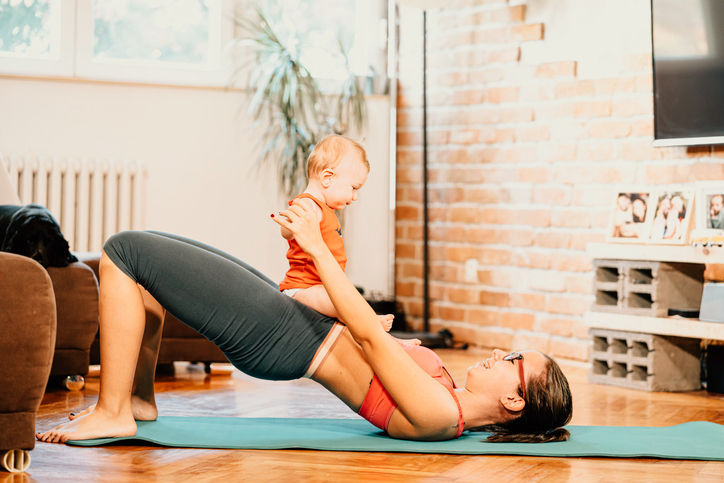
Mat Pilates uses your bodyweight as resistance and produces measurable strength, endurance, and flexibility gains. A mat, a small amount of floor space, and consistent practice are enough to make real progress. If you do want to build out a small home setup, our at-home Pilates setup guide covers what's worth buying and what isn't.
Learn How to do Mat Pilates Exercises Correctly! Grab the Free Guide
Myth 5: Pilates Is Just Stretching
Stretching is part of Pilates, but it isn't the main event. Pilates is a strength-focused discipline that trains the deep core, the muscles around the spine, and the small stabilizers around the joints. Those are the same muscles a physical therapist usually targets first when someone walks in with chronic back pain.
That overlap isn't coincidental. A 2022 network meta-analysis in the Journal of Orthopaedic & Sports Physical Therapy identified Pilates as one of the most effective exercise interventions for reducing pain and disability in adults with chronic low back pain (Fernández-Rodríguez et al., 2022). That kind of clinical impact requires real effort, clearly not just stretching.
Myth 6: Pilates Is Too Slow to Be Effective
"Slow" in Pilates means controlled, not lazy. Holding a position with full muscular engagement for several seconds is a different kind of difficult than rushing through reps, and it's the slow tempo that builds time-under-tension and recruits the deep stabilizers most other workouts skip past. Once you've done the Hundred or a slow series of leg circles, the "too slow" concern tends to evaporate quickly.
It also turns out that slower, consistent practice produces better long-term results than going hard occasionally. Sustainability beats intensity over a year, which is why staying consistent with a Pilates routine matters more than chasing the hardest possible session every time.
Is Pilates Hard? The Bottom Line
So, is Pilates hard? Yes and no. Pilates is more challenging than it looks, more accessible than most people think, and more strength-focused than "just stretching." The myths about who it's for and how hard it is are leftovers from outdated marketing and internet fodder, not from the practice itself. The best way to find out where you stand is to try it.
Make It Your Practice
If you're thinking about starting a Pilates routine, let us help! Prompt Pilates is an app that builds a personalized Pilates session around your body, your equipment and the time you have, and progresses as you get stronger. Join the Prompt Pilates waitlist for two free weeks at launch.

References
Fernández-Rodríguez, R., Álvarez-Bueno, C., Cavero-Redondo, I., Torres-Costoso, A., Pozuelo-Carrascosa, D. P., Reina-Gutiérrez, S., Pascual-Morena, C., & Martínez-Vizcaíno, V. (2022). Best exercise options for reducing pain and disability in adults with chronic low back pain: Pilates, strength, core-based, and mind-body. A network meta-analysis. Journal of Orthopaedic & Sports Physical Therapy, 52(8), 505-521. https://doi.org/10.2519/jospt.2022.10671
Kloubec, J. A. (2010). Pilates for improvement of muscle endurance, flexibility, balance, and posture. Journal of Strength and Conditioning Research, 24(3), 661-667. https://doi.org/10.1519/JSC.0b013e3181c277a6
Sekendiz, B., Altun, Ö., Korkusuz, F., & Akın, S. (2007). Effects of Pilates exercise on trunk strength, endurance and flexibility in sedentary adult females. Journal of Bodywork and Movement Therapies, 11(4), 318-326. https://doi.org/10.1016/j.jbmt.2006.12.002


Comments